Kurt Vonnegut on Why Art Matters for Everyone
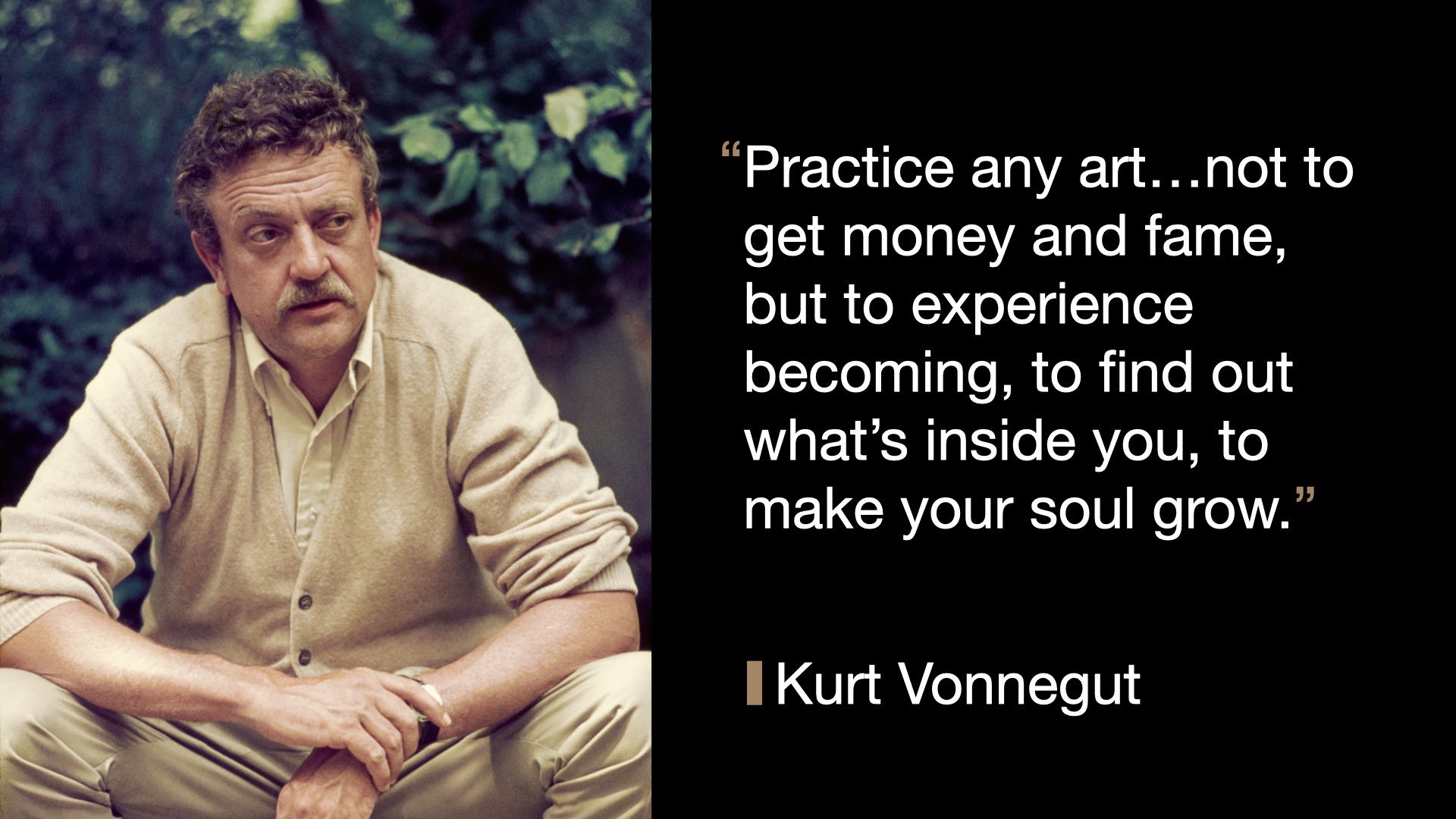
Kurt Vonnegut (1922–2007) was one of the truly great American writers of our time. In 2006, when Vonnegut was 84, a few students at Xavier High School in New York sent letters to the the legendary author asking him to visit their class. The fact that Vonnegut actually replied shows what a thoughtful and kind man he was. Vonnegut politely declined the invitation with humor and with grace: "I don't make public appearances any more because I now resemble nothing so much as an iguana," wrote Vonnegut. However, his letter offered beautiful wisdom and advice for these young students. You can see the entire letter here. Below is the passage that spoke to me most (and then listen to James Earl Jones read the entire short letter to the students in 2024.):
"Practice any art, music, singing, dancing, acting, drawing, painting, sculpting, poetry, fiction, essays, reportage, no matter how well or badly, not to get money and fame, but to experience becoming, to find out what's inside you, to make your soul grow."
— Kurt Vonnegut
You'll never get a job doing that!
Around the world, mass school systems still do not understand the role of art in developing a child's mind. Yes, they sometimes pay lip service to the importance of art education, and then art is the first thing to go when money is tight. Participating in the arts—learning to play an instrument or to express yourself through painting, writing, acting, etc.—are valuable not because they allow you to tick a box on a job application ten years in the future, the arts are valuable in and of themselves. What is a life without art in it? What is a school worth without a deep commitment to the whole mind (and body) of the student, which includes art. Pablo Picasso famously said, "All children are artists. The problem is how to remain an artist once we grow up.”
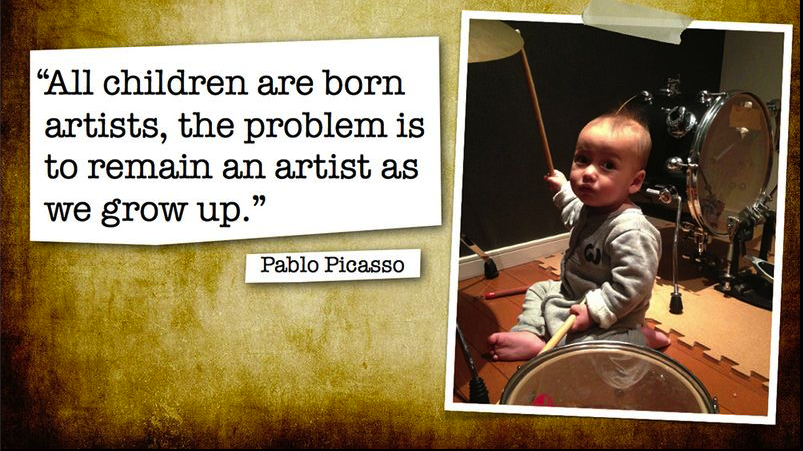
Above: Presentation slide with famous Picasso quote featuring a photo of my son banging on the drums before he was old enough to walk.
"You'll never get a job doing that" is something I actually heard in high school when I spent so much energy on music. Later I heard the same thing from business or engineering students when I was getting a degree in Philosophy from OSU. Looking back, I do not regret spending so much energy on music, my only regret is that I did not spend *more* energy exploring other disciplines in the arts. I think I would be a much better public speaker today, for example, if I would have studied drama and put myself up on a stage acting in front of a large audience, one of the scariest things one can do.
"You were probably steered benignly away from things at school when you were a kid, things you liked, on the grounds that you would never get a job doing that. Is that right? Don't do music, you're not going to be a musician; don't do art, you won't be an artist. Benign advice—now, profoundly mistaken."
— Sir Ken Robinson
The role of art & music in education
The advice from Kurt Vonnegut ties in nicely with a piece that came out a couple of years ago by Quincy Jones called Arts Education in America. Quincy asks "...can we really run the risk of becoming a culturally bankrupt nation because we have not inserted a curriculum into our educational institutions that will teach and nurture creativity in our children?" The most interesting part of Quincy's article were the words taken from the 1943 War Department Education Manual EM 603 that got its recommendations on jazz completely wrong. (Read it—you'll be amazed!) Kind of makes you wonder what else—in spite of good intentions—our educational institutions and leaders are getting completely wrong today? If our recommendations are based on the assumptions that science is not a place for creative thinking or that the arts/humanities have no room for analysis and logic or that students need to make a choice about what kind of person they are—logical or intuitive—then something tells me we're getting it wrong. We need both science and the arts...and we need to do better teaching both.
"It has been proven time and time again in countless studies that students who actively participate in arts education are twice as likely to read for pleasure, have strengthened problem-solving and critical thinking skills, are four times more likely to be recognized for academic achievement, four times more likely to participate in a math and science fair...."
— Quincy Jones
Technology is not enough
Technology such as LLMs can be useful for us so long as they are not a replacement for our own thinking and creativity. We need the messy process of engaging in the arts in our lives “no matter how well or badly…to experience becoming, to find out what's inside…" as Vonnegut said. I was always attracted to Apple, and eventually worked for them in Cupertino, because I felt that Apple understood the importance of the liberal arts. In the ‘80s, Steve Jobs talked about how the computer should be like a bicycle for our mind, helping us grow and enabling our creativity in new and exciting ways. In 2011, Steve spoke about how Apple was different than other tech companies because it saw itself as being at the intersection of technology and the arts, where design, storytelling, aesthetics, and human needs helped shape what engineers and programmers created. It’s arguable just how much Apple has been able to remain true to this vision, but historically this has been Apple’s point of view: That technology can be a great amplifier of our own creativity, skills, and passions, not a replacement for them.
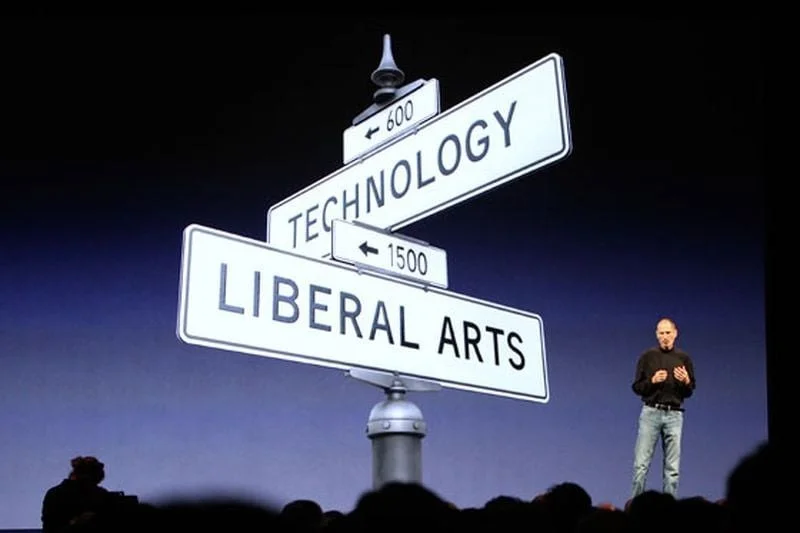
Steve Jobs presenting on stage in 2011.