Design Fundamentals: Contrast, Repetition, Alignment, Proximity
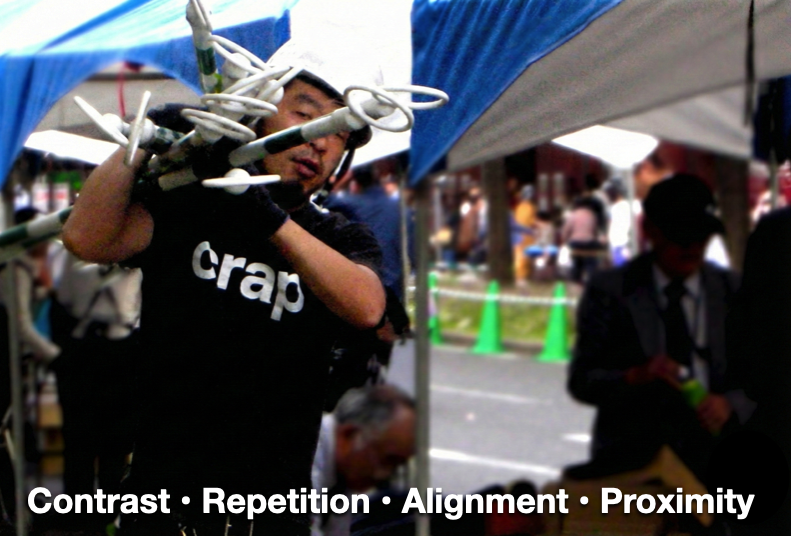
I snapped this photo may years ago during a Midosuji street event in Osaka. The worker’s text (Helvetica or Arial?) on his t-shirt caught my eye and is a good reminder: If you want to avoid creating crap visuals, remember C-R-A-P.
Sometime in the mid-1990s, I serendipitously found a lovely book called The Non-Designer’s Design Book by Robin Williams (the designer). As the title implies, this is a book for non-designers who need/want to learn some fundamentals about design that will help them make better graphics. The book focuses on four essential concepts: Proximity, Alignment, Repetition, Contrast. So the reader would encounter the concepts in the book as the mnemonic P-A-R-C, but I use the mnemonic C-R-A-P. That is, we can avoid creating crap by remembering the principles that make up C-R-A-P. Of course, there is much more to graphic design than these four fundamental concepts, but understanding them can give anyone a solid foundation on which to build.
Contrast:
When you put strong visual differences on the screen—size, color, weight, shape, and so on—you make it instantly clear what matters most and where the eye should go first.
Repetition: When certain visual elements—type, color, lines, shapes—repeat, they subtly connect slides together and create a sense of unity and familiarity.
Alignment: When objects line up with something else on the slide, along a common edge or center, they sit on an invisible grid which then makes the design feel clean, related, and easy to follow.
Proximity: (Gestalt principle)
When things are close to each other, we read them as belonging together; when they are separated by space, we read them as different, so simple spacing can suggest structure and relationships.
In the Presentation Zen book, I dedicate over a dozen pages to explaining these four concepts and showing plenty of examples. Below are screen shots of four of the pages. If you would like a PDF just of the Contrast, Repetition, Alignment, Proximity section (pages 174-187), please click here or on the “Download PDF” button below.
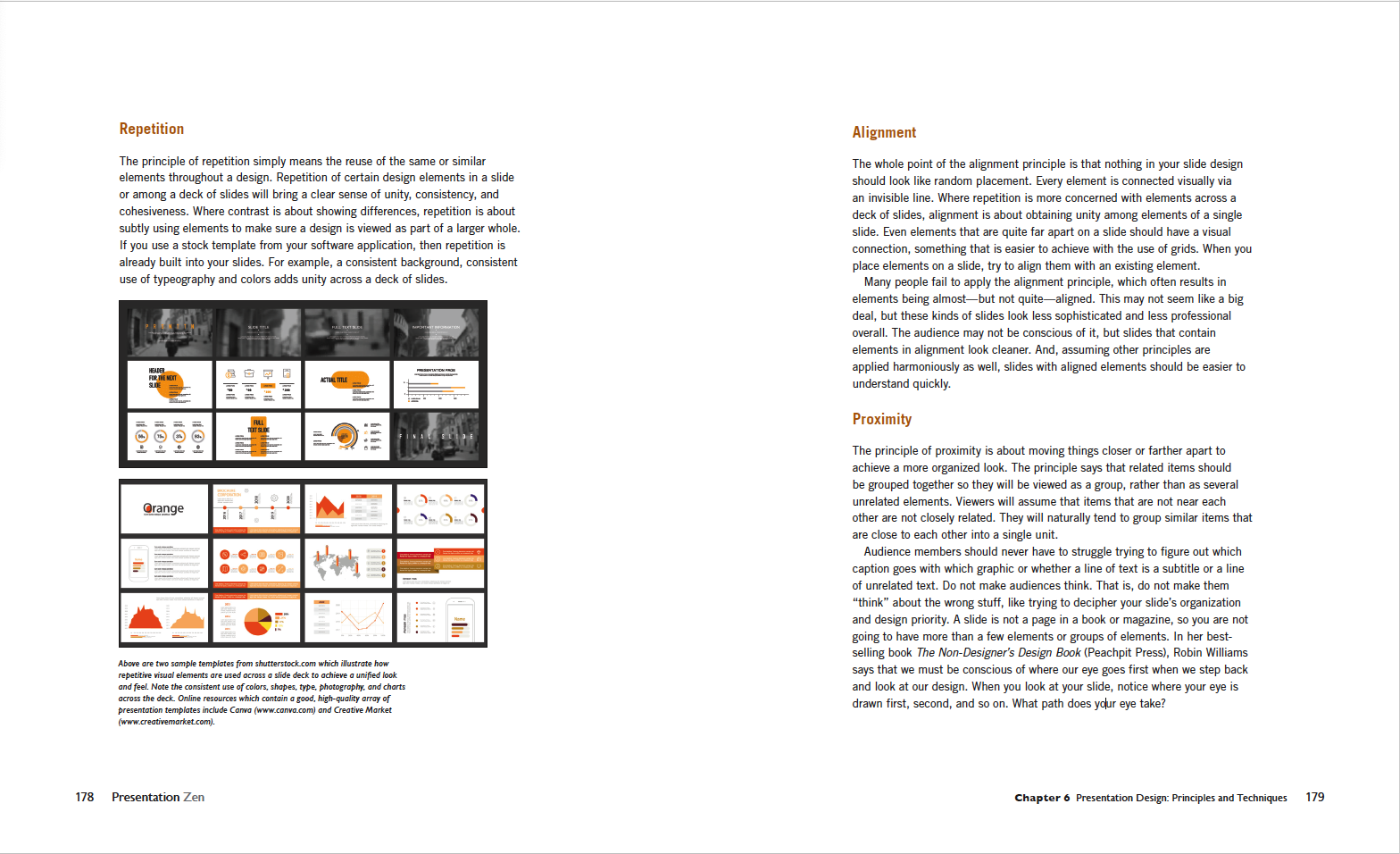
Pages 178-179 of Presentation Zen.
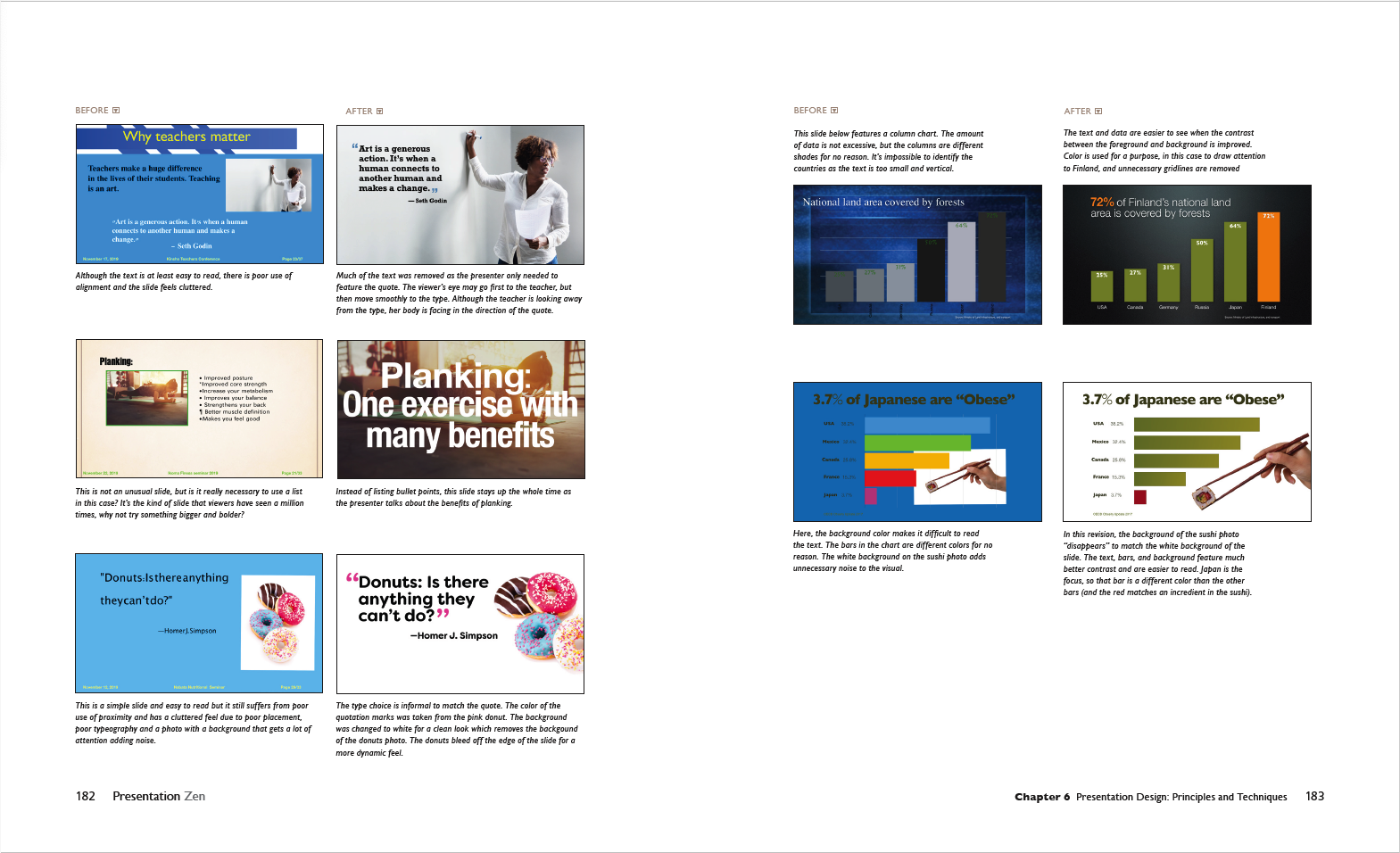
Pages 182-183 of Presentation Zen.
Click on image to download the section on Contrast, Repetition, Alignment, and Proximity from the book Presentation Zen, 3rd Edition.