What is visual thinking? How to use it to prepare your work.
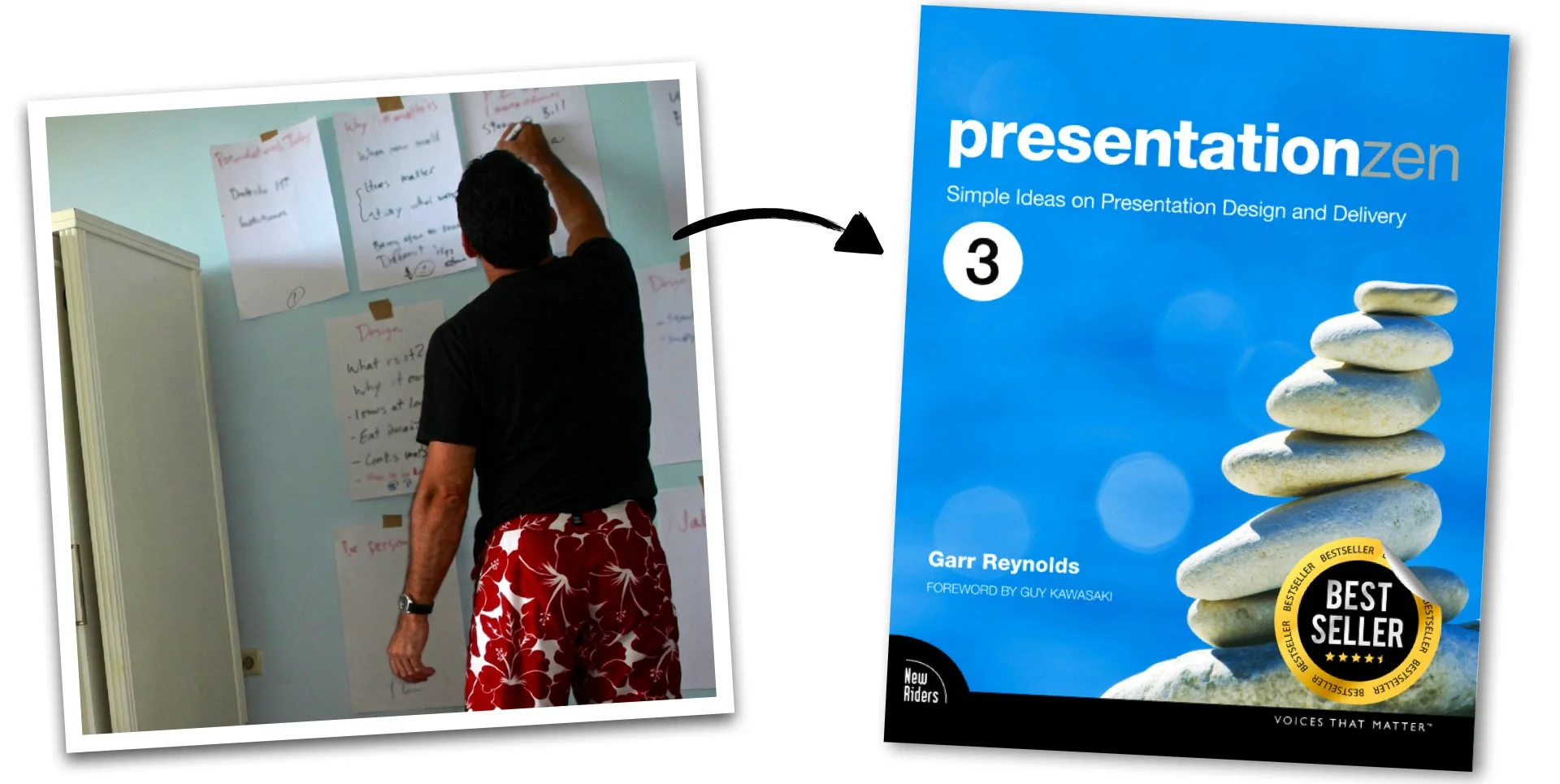
From ideas on a wall to a published book.
Turning words/text into visual representations is a part of visual thinking, but it's only a small part. For example, in this photo of me above (left) in the summer of 2007 in a Waikiki hotel—six months before the first edition of Presentation Zen was published—I'm putting ideas—mostly in text form—onto sheets of paper before I begin writing the actual book (right). Eventually, those ideas will become an outline and then a book, but first I needed to get all the ideas out in a space where I could see the big picture and see how the parts can fit together. I needed to go from the abstract (a new book on presentations) to the concrete (content details plus structure). I knew I wanted ten chapters for the book, so I placed ten large sheets of paper on the wall, and then over several days, I filled in all the sheets (chapters) with a word or two or a crude drawing representing each idea of concept that I wanted to cover.
This process was not sequential; it felt more spatial somehow since I had a literal space that was much larger than a 14-inch screen. By using the wall as I visualized, imagined, and ideated, I felt more connected to what I was writing/sketching since those large sheets of paper were occupying the same space in that small hotel room that I was. There is nothing wrong with a screen, of course, but ideating with a notebook and pen or on a whiteboard provides a refreshing change of approach that stimulates creative flow.
Ninety percent of what I put on the paper was text with some lines and doodles and stick figures. However, this is still visual thinking as what I was doing was externalizing my internal thoughts and transforming my ideas/concepts into something more tangible in a space outside of my head. It may look linear, but actually I was free to go back and forth and see the whole book in a sense on one wall.
My thinking is scattered sometimes and I feel that ideas come and go and I struggle to remember them. One of the benefits of visual thinking is that we can get ideas out there in space, which for many people has a calming effect as our thoughts and ideas are no longer abstract and ephemeral but now exist concretely in space where we can then build upon them.
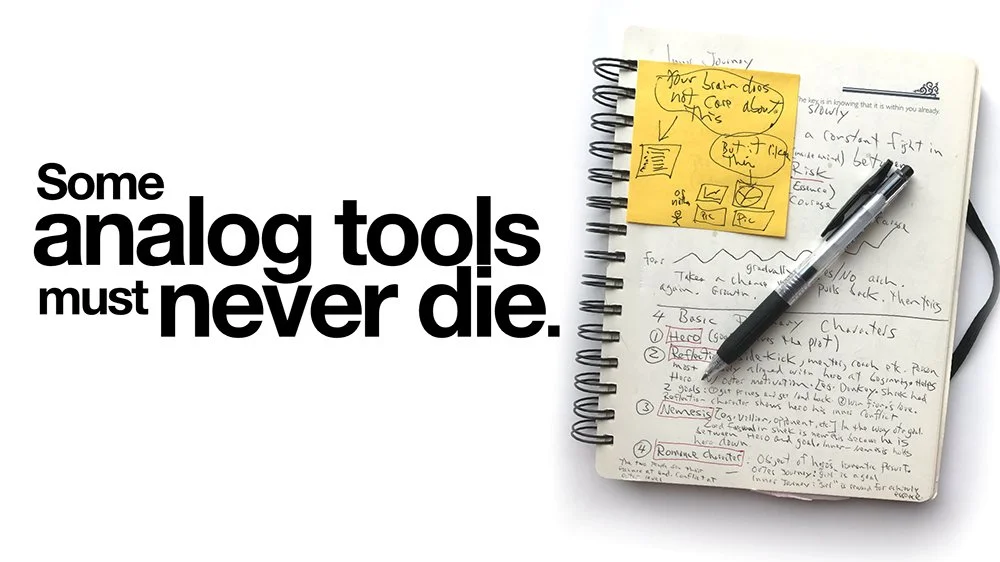
Notebooks, sticky notes, and whiteboards are my favorite tools for preparation.
Even to this day, I plan with a pen and notebook or sketch out ideas on a whiteboard first. In preparing a presentation, the time and struggle involved are not in vain, for this wracking of my brain is a kind of desirable difficulty that helps me determine what is important for a particular audience. The time and effort I put into discerning the content and making choices about structure give me a stronger sense of ownership of the material.